


As a manufacturer with years of hands-on experience in building envelope solutions, I have consistently observed a critical pain point on construction sites: material handling and installation efficiency. Heavy, stiff, or difficult-to-handle reinforcement materials not only slow down project timelines but also compromise the quality and consistency of the waterproofing system. This is precisely why we have focused our development efforts on creating a non-woven fabric that addresses these challenges directly—a material that is genuinely lightweight, remarkably flexible, and engineered for easy installation.
The Weight Advantage: Why Lightweight Matters
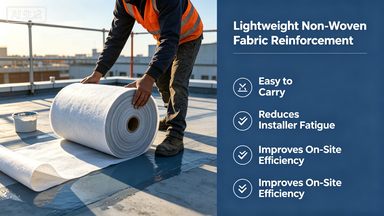
Construction productivity is often measured in square meters installed per man-hour. Every extra kilogram of material weight translates to increased handling effort, slower deployment, and greater installer fatigue. Our stitchbond non-woven fabric is designed with a weight range typically between 60 and 160 grams per square meter , making it significantly lighter than conventional roofing felts that can weigh five to seven times as much .
This lightweight characteristic delivers measurable benefits on site. A single worker can easily carry, position, and lay multiple rolls without mechanical assistance. For elevated work, such as on rooftops or scaffolding, reduced weight means enhanced safety—lower risk of dropping heavy materials and less physical strain on the installation crew. The result is a smoother workflow that directly contributes to overall construction efficiency.
Flexibility: Adapting to Complex Substrates
One of the most challenging aspects of waterproofing construction is dealing with irregular surfaces, standing seam metal roof decks, and complex details such as upstands, pipe penetrations, and wall-floor intersections . Traditional rigid reinforcement materials often fail to conform to these geometries, creating gaps, air pockets, or weak points in the waterproofing system.
Our flexible non-woven fabric, manufactured using stitchbond technology, readily conforms to irregular surfaces without wrinkling or tearing . This conformability ensures that the fabric makes full contact with the substrate, eliminating the risk of air entrapment and ensuring excellent adhesion of the waterproofing coating . In practice, this means a more reliable and durable waterproofing layer, especially in areas that are traditionally difficult to detail.
Engineered for Easy Installation
Easy installation is not a marketing claim—it is a deliberate outcome of material engineering. Several features of our non-woven fabric are specifically designed to simplify the application process:
Smooth and Soft Texture
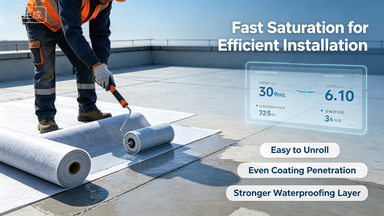
The stitchbond process does not involve the hardening characteristics found in needle-punched or thermally bonded nonwovens. The fabric remains as soft as the original fiber web , making it easy to unroll, position, and smooth into place.
Rapid Saturation
The fabric’s open structure allows liquid waterproofing coatings—whether water-based emulsions, solvent-type coatings, or acrylic systems—to saturate quickly and evenly . This ensures complete encapsulation of the reinforcing fabric, which is essential for achieving a monolithic waterproofing layer.
Tear Resistance Combined with Elongation
While being easy to handle, the fabric does not easily tear or wrinkle during application . This is particularly important when working around penetrations or on vertical surfaces, where the fabric needs to be manipulated without damaging its integrity.
Impact on Construction Efficiency
The cumulative effect of these characteristics is a measurable improvement in construction efficiency. Field experience shows that using a lightweight, flexible reinforcement fabric can reduce installation time compared to heavier, stiffer alternatives. The ability to work faster without compromising quality translates directly to lower labor costs and faster project completion.
Furthermore, the fabric’s design ensures that the waterproofing system can achieve increased and uniform thickness . This not only enhances the mechanical strength and durability of the system but also improves its crack-bridging properties , making the installation more resilient to future substrate movement.
Application Scenarios
Our lightweight and flexible non-woven fabric is ideally suited for:
- Roof Waterproofing Systems: As a reinforcing layer for liquid-applied roofing membranes, particularly on complex roofs with multiple penetrations and details.
- Balcony and Terrace Waterproofing: Where flexibility and crack-bridging are essential to handle thermal movement.
- Basement and Below-Grade Waterproofing: Where easy handling in confined spaces is a priority.
- Localized Reinforcement: For reinforcing critical details such as cracks, upstands, and floor-wall junctions .
Commitment to Quality
Our fabric is manufactured from 100% pure polyester, ensuring excellent aging resistance and performance across a wide temperature range. The quality control process ensures consistent weight, thickness, and tear strength, which are essential for predictable performance on site. We understand that when a contractor chooses our product, they are trusting us to contribute to their success—a responsibility we take seriously.
Frequently Asked Questions (FAQ)
Q1: What makes your non-woven fabric lightweight enough to improve on-site handling?
A: Our stitchbond non-woven fabric is manufactured in a weight range of 60 to 160 gsm . In practical terms, this means a single worker can easily carry and position multiple rolls without the need for mechanical lifting equipment. For large-scale projects, this weight reduction directly translates to faster material deployment and reduced installer fatigue.
Q2: How does the fabric’s flexibility benefit the waterproofing system?
A: The fabric readily conforms to irregular surfaces such as standing seam metal roofs, upstands, and wall-floor intersections . This ensures full substrate contact, eliminating gaps and air pockets that could compromise the waterproofing layer. In complex projects, this conformability is essential for achieving a reliable seal in difficult-to-detail areas.
Q3: Is the fabric easy to install without specialized tools?
A: Yes. The fabric’s soft texture and tear resistance make it easy to unroll, position, and smooth into place. It saturates quickly with most liquid waterproofing coatings , allowing for a straightforward application process using standard rollers or brushes. No specialized tools are required.
Q4: What types of waterproofing coatings are compatible with this fabric?
A: The fabric works with most liquid-applied waterproofing systems, including water-based asphalt emulsions, acrylic coatings, solvent-type coatings, and mastics . Its open structure promotes rapid and even saturation, which is critical for achieving a monolithic waterproofing membrane.
Q5: Does the fabric’s lightweight and flexible design compromise its strength or durability?
A: Not at all. Despite its lightweight nature, the fabric offers excellent tear strength, tensile strength, and puncture resistance . The stitchbond structure provides robust reinforcement without sacrificing flexibility, ensuring that the finished waterproofing system is both strong and durable.
Post time: Aug-21-2026
- English
- French
- German
- Portuguese
- Spanish
- Russian
- Japanese
- Korean
- Arabic
- Irish
- Greek
- Turkish
- Italian
- Danish
- Romanian
- Indonesian
- Czech
- Afrikaans
- Swedish
- Polish
- Basque
- Catalan
- Esperanto
- Hindi
- Lao
- Albanian
- Amharic
- Armenian
- Azerbaijani
- Belarusian
- Bengali
- Bosnian
- Bulgarian
- Cebuano
- Chichewa
- Corsican
- Croatian
- Dutch
- Estonian
- Filipino
- Finnish
- Frisian
- Galician
- Georgian
- Gujarati
- Haitian
- Hausa
- Hawaiian
- Hebrew
- Hmong
- Hungarian
- Icelandic
- Igbo
- Javanese
- Kannada
- Kazakh
- Khmer
- Kurdish
- Kyrgyz
- Latin
- Latvian
- Lithuanian
- Luxembou..
- Macedonian
- Malagasy
- Malay
- Malayalam
- Maltese
- Maori
- Marathi
- Mongolian
- Burmese
- Nepali
- Norwegian
- Pashto
- Persian
- Punjabi
- Serbian
- Sesotho
- Sinhala
- Slovak
- Slovenian
- Somali
- Samoan
- Scots Gaelic
- Shona
- Sindhi
- Sundanese
- Swahili
- Tajik
- Tamil
- Telugu
- Thai
- Ukrainian
- Urdu
- Uzbek
- Vietnamese
- Welsh
- Xhosa
- Yiddish
- Yoruba
- Zulu
- Kinyarwanda
- Tatar
- Oriya
- Turkmen
- Uyghur