


As a manufacturer dedicated to building envelope solutions, I have observed a recurring challenge among specifiers, contractors, and architects: the confusion surrounding vapour barriers and breather membranes. These two products are often discussed as if they are interchangeable, yet they serve fundamentally different functions in building physics. Understanding this distinction is not merely an academic exercise—it is essential for designing structures that are energy-efficient, durable, and free from moisture-related failures.
Clarifying the Terminology: Vapour Barrier vs. Breathable Membrane
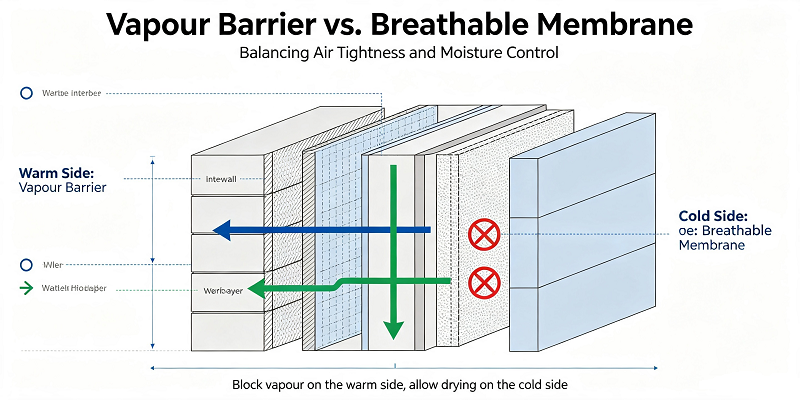
The terms are frequently used interchangeably, but precision matters in construction . A vapour barrier is a material that is highly resistant to the passage of moisture vapour. In technical terms, it has an equivalent air layer thickness (Sd value) of 100 metres or more, making it effectively impermeable to both water and vapour . In contrast, a breathable membrane (also called a vapour-permeable or low-resistance membrane) allows the passage of moisture vapour through it while remaining waterproof to liquid water . A breather membrane typically has an Sd value of ≤0.1 metres, making it highly vapour-open .
Where Do Air Tightness and Moisture Control Intersect?
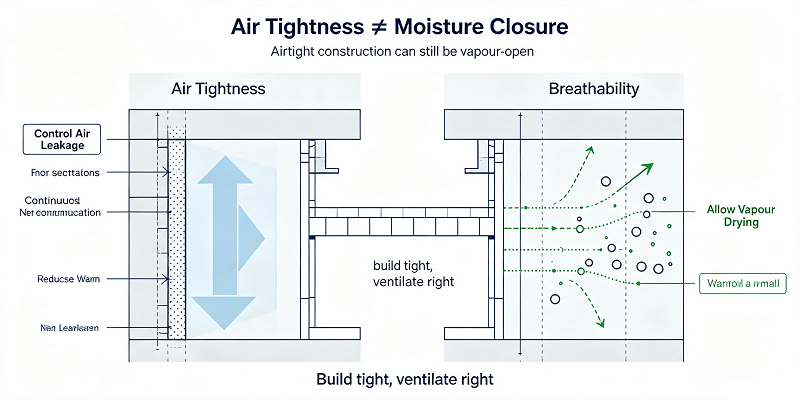
Air tightness and breathability address two different aspects of building performance. Air tightness is about controlling uncontrolled air leakage through gaps, cracks, and joints in the building fabric. It prevents warm, moist interior air from escaping into colder building cavities, which is the primary mechanism by which moisture is transported—far more significant than vapour diffusion alone . Breathability, by contrast, refers to the ability of a building assembly to allow moisture vapour to diffuse through it, enabling the structure to dry safely .
Airtight buildings are not necessarily moisture-closed. As building science research confirms, buildings can and should be both airtight and vapour-open . The goal is to “build tight, ventilate right,” a principle endorsed by the Passivhaus standard .
The Role of Each Membrane in Building Physics
Understanding building physics is key to placing these membranes correctly within a wall or roof assembly:
are installed on the warm side of the thermal insulation layer. Their purpose is to prevent moisture vapour from diffusing from the warm interior into the colder building fabric, where it might condense . They are typically used in humid environments such as swimming pools or where high interior humidity is expected.
are installed on the cold side of the insulation layer (outside the building). They protect the insulation from wind and driven rain while allowing any moisture that does enter the assembly to evaporate and escape . This outward drying capacity is critical for preventing interstitial condensation and protecting timber frames from rot .
In modern construction, the term “vapour control layer” (VCL) has largely been replaced by “air and vapour control layer” (AVCL), driven by stricter airtightness requirements in building regulations such as BS 5250:2021 . This evolution reflects a recognition that limiting air movement is as important as controlling vapour diffusion.
Managing Condensation and Mould
The persistence of moisture in building elements can lead to condensation, which then causes efflorescence, mould growth, and structural deterioration . A correctly specified vapour barrier, placed on the interior side, minimises the risk of interstitial condensation. Meanwhile, a breathable membrane on the exterior side ensures the building can dry to the outside .
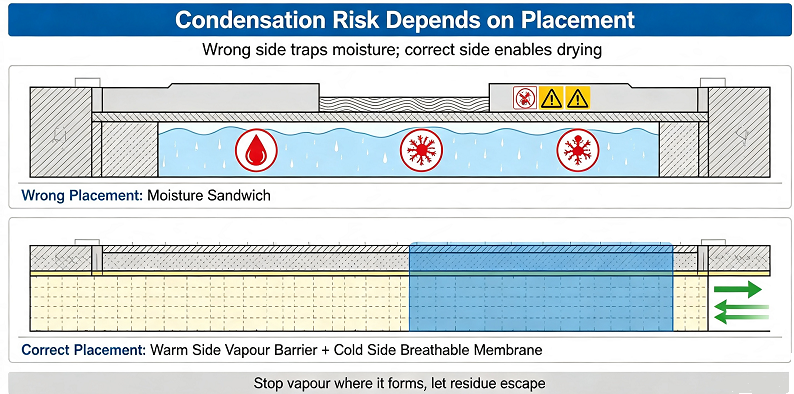
If a vapour barrier is placed on the wrong side of the insulation, it can trap moisture within the assembly, creating a classic “moisture sandwich” that promotes decay. Similarly, using a vapour-impermeable material where a breather membrane is needed can prevent drying, leading to long-term damage .
Selecting the Right Product
There is no single answer for all projects. A competent technician will recommend the appropriate product after performing a hygrothermal analysis, considering climatic conditions, insulation type, and structural components . The principle is to block vapour where it forms (on the warm side) while allowing any residue to pass through on the cold side so the waterproof layer remains intact .
Frequently Asked Questions (FAQ)
Post time: Jul-21-2026
- English
- French
- German
- Portuguese
- Spanish
- Russian
- Japanese
- Korean
- Arabic
- Irish
- Greek
- Turkish
- Italian
- Danish
- Romanian
- Indonesian
- Czech
- Afrikaans
- Swedish
- Polish
- Basque
- Catalan
- Esperanto
- Hindi
- Lao
- Albanian
- Amharic
- Armenian
- Azerbaijani
- Belarusian
- Bengali
- Bosnian
- Bulgarian
- Cebuano
- Chichewa
- Corsican
- Croatian
- Dutch
- Estonian
- Filipino
- Finnish
- Frisian
- Galician
- Georgian
- Gujarati
- Haitian
- Hausa
- Hawaiian
- Hebrew
- Hmong
- Hungarian
- Icelandic
- Igbo
- Javanese
- Kannada
- Kazakh
- Khmer
- Kurdish
- Kyrgyz
- Latin
- Latvian
- Lithuanian
- Luxembou..
- Macedonian
- Malagasy
- Malay
- Malayalam
- Maltese
- Maori
- Marathi
- Mongolian
- Burmese
- Nepali
- Norwegian
- Pashto
- Persian
- Punjabi
- Serbian
- Sesotho
- Sinhala
- Slovak
- Slovenian
- Somali
- Samoan
- Scots Gaelic
- Shona
- Sindhi
- Sundanese
- Swahili
- Tajik
- Tamil
- Telugu
- Thai
- Ukrainian
- Urdu
- Uzbek
- Vietnamese
- Welsh
- Xhosa
- Yiddish
- Yoruba
- Zulu
- Kinyarwanda
- Tatar
- Oriya
- Turkmen
- Uyghur