


Advanced 3-Layer Thermal Laminated Waterproof Breathable Membrane: Setting New Standards for Air and Water Tightness in Building Envelopes
As a manufacturer deeply engaged in the development of high-performance building materials, I have witnessed firsthand how the demands on building envelopes have intensified over the past decade. Architects, contractors, and building owners are no longer satisfied with basic protection. They require systems that deliver exceptional durability, energy efficiency, and long-term structural integrity. This is precisely why we have invested heavily in perfecting our advanced 3-layer thermal laminated waterproof breathable membrane.
.jpg)
The Engineering Behind the Membrane
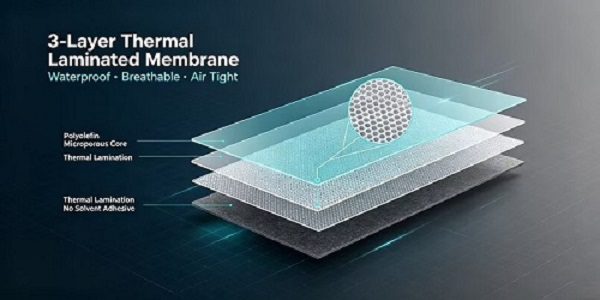
Our waterproof breathable membrane is not a simple film. It is a precisely engineered composite consisting of a middle layer of polyolefin microporous membrane, thermally laminated between two robust polymer protective layers. This is where the concept of advanced compounding truly comes to life. Unlike conventional adhesive-bonded products, our thermal lamination process uses controlled heat and pressure to fuse these three distinct layers into a single, inseparable structure.
This advanced compounding technique offers significant advantages. By eliminating the need for solvent-based adhesives, we avoid the risks of adhesive degradation, delamination, or off-gassing over time. The bond is permanent, consistent across the entire roll, and maintains its integrity even under prolonged exposure to temperature fluctuations and mechanical stress. In essence, advanced compounding is the foundation upon which the membrane's superior performance is built.
Delivering Superior Air and Water Tightness
When we speak of air tightness and water tightness in the context of a building envelope, we are addressing two of the most critical factors influencing building performance and longevity.
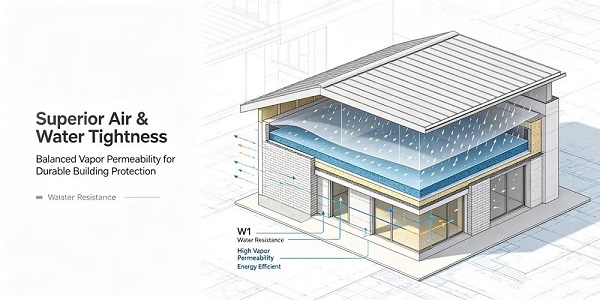
First, let's consider air tightness. Uncontrolled air leakage through the building envelope accounts for a significant portion of heating and cooling energy losses. Our membrane, with its dense, multi-layer structure, acts as a highly effective air barrier. It prevents the unwanted ingress of cold drafts in winter and hot, humid exterior air in summer. This controlled environment directly translates to reduced energy consumption, lower utility bills, and a more stable indoor climate for occupants.
Second, water tightness is non-negotiable in any building protection strategy. Our membrane achieves W1 class water resistance, a certification that ensures it can withstand a hydrostatic pressure of 1500mm for over two hours. This level of protection is crucial for both pitched roofs and exterior walls, particularly in regions prone to wind-driven rain. By effectively blocking liquid water from penetrating the insulation and structural layers, the membrane safeguards the building's core from moisture-related damage such as rot, corrosion, and mold growth.
However, what truly distinguishes a high-performance material is its ability to balance seemingly contradictory properties. While our 3-layer laminated membrane excels at blocking water and air, it simultaneously demonstrates high vapor permeability. With a water vapor transmission rate of ≥1500 g/m² per 24 hours, it allows trapped moisture within the building assembly to escape. This prevents condensation buildup, a common cause of hidden decay and reduced insulation effectiveness. In short, the membrane breathes, ensuring the building structure remains dry and healthy.
The Advantages of a High-Performance Material
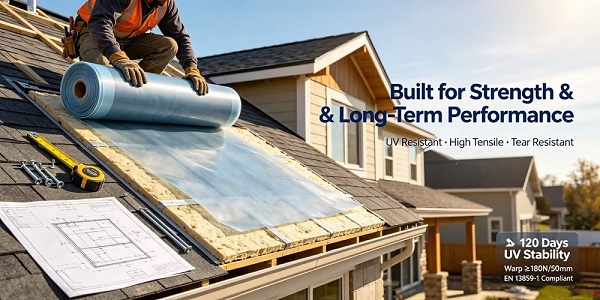
A high-performance material is defined not just by its initial properties, but by its consistent performance over the lifespan of the building. Our membrane is formulated from durable, UV-resistant polyolefin. It withstands 120 days of UV exposure testing, a critical attribute for products that often remain exposed during the construction phase. This UV stability, combined with excellent tensile strength (warp ≥180N/50mm) and high tear resistance (warp ≥110N/50mm), means the membrane can handle the rigors of installation without tearing or puncturing. It offers lasting resilience against wind uplift and structural movement.
Furthermore, our rigorous quality control ensures that every roll of our 3-layer laminated membrane meets demanding international standards, including GB/T and EN 13859-1. We provide detailed technical data, from mass per unit area (110g/m² and 140g/m²) to SD values, giving engineers and specifiers the transparency they need for accurate building physics calculations.
Commitment to Quality and Service
Our expertise lies in understanding the real-world challenges of construction. We know that project timelines are tight and reliability is paramount. That is why we stock standard roll sizes (1.5m x 50m) and offer flexible packaging options to meet diverse project logistics. Our role as a supplier extends beyond delivering goods; we partner with our clients to provide technical support, ensuring correct specification and application. We believe that by sharing our deep knowledge of advanced compounding and material science, we empower our customers to build better, more sustainable buildings.
In conclusion, our advanced 3-layer thermal laminated waterproof breathable membrane represents a synthesis of material science and practical engineering. By delivering superior air and water tightness through advanced compounding, it provides a dependable, high-performance solution for modern building envelopes.
Frequently Asked Questions (FAQ)
Q1: How does the 3-layer thermal lamination process differ from adhesive lamination, and why does it matter?
A: Thermal lamination uses controlled heat and pressure to fuse the layers together, creating a permanent, homogenous bond without adhesives. This matters because adhesive-bonded membranes can suffer from adhesive breakdown or delamination over time, especially under temperature swings or moisture stress. Thermal lamination ensures long-term structural integrity, maintaining the membrane's air and water tightness throughout the building's lifespan.
Q2: Can this membrane be used on both pitched roofs and exterior walls?
A: Yes, absolutely. Our membrane is designed as a versatile solution for the entire building envelope. It is commonly applied under roof tiles, slates, or metal roofing, as well as behind exterior wall cladding and in insulation systems. In both applications, it serves the dual purpose of protecting against external moisture while allowing internal vapor to escape.
Q3: What are the specific performance standards this membrane meets?
A: Our membrane is tested according to rigorous standards. It achieves W1 class water resistance per GB/T 328.10-2007 (≥1500mm for 2 hours). Its water vapor transmission is measured per GB/T 1037-1998 (≥1500 g/m²·24h). It also meets Reaction to Fire Class E and complies with the requirements of EN 13859-1 for flexible sheets for waterproofing.
Q4: How does the membrane contribute to the energy efficiency of a building?
A: By providing superior air tightness, our membrane significantly reduces uncontrolled air infiltration. This minimizes heat loss in winter and heat gain in summer, thereby reducing the workload on HVAC systems. This air-tightness, combined with proper insulation, is a cornerstone of any energy-efficient building design and can contribute to green building certifications.
Q5: What packaging and customization options are available for bulk B2B orders?
A: Each roll is standardly packed in a plastic bag to protect it during transport and storage. We understand that large-scale projects may have specific logistical requirements, so we offer flexible packaging and roll size customization upon request. We work closely with our B2B partners to ensure the product is delivered in the most convenient and cost-effective manner for their specific project needs.
Post time: Jul-10-2026
- English
- French
- German
- Portuguese
- Spanish
- Russian
- Japanese
- Korean
- Arabic
- Irish
- Greek
- Turkish
- Italian
- Danish
- Romanian
- Indonesian
- Czech
- Afrikaans
- Swedish
- Polish
- Basque
- Catalan
- Esperanto
- Hindi
- Lao
- Albanian
- Amharic
- Armenian
- Azerbaijani
- Belarusian
- Bengali
- Bosnian
- Bulgarian
- Cebuano
- Chichewa
- Corsican
- Croatian
- Dutch
- Estonian
- Filipino
- Finnish
- Frisian
- Galician
- Georgian
- Gujarati
- Haitian
- Hausa
- Hawaiian
- Hebrew
- Hmong
- Hungarian
- Icelandic
- Igbo
- Javanese
- Kannada
- Kazakh
- Khmer
- Kurdish
- Kyrgyz
- Latin
- Latvian
- Lithuanian
- Luxembou..
- Macedonian
- Malagasy
- Malay
- Malayalam
- Maltese
- Maori
- Marathi
- Mongolian
- Burmese
- Nepali
- Norwegian
- Pashto
- Persian
- Punjabi
- Serbian
- Sesotho
- Sinhala
- Slovak
- Slovenian
- Somali
- Samoan
- Scots Gaelic
- Shona
- Sindhi
- Sundanese
- Swahili
- Tajik
- Tamil
- Telugu
- Thai
- Ukrainian
- Urdu
- Uzbek
- Vietnamese
- Welsh
- Xhosa
- Yiddish
- Yoruba
- Zulu
- Kinyarwanda
- Tatar
- Oriya
- Turkmen
- Uyghur