


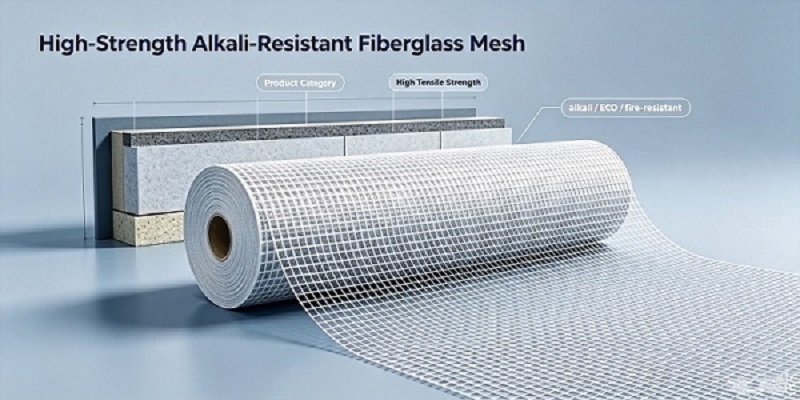
High-Strength Alkali-Resistant Fiberglass Mesh:
The Essential Reinforcement for Durable EIFS and ETICS Systems
As a manufacturer with years of hands-on experience in the building materials sector, I have observed a critical factor tat separates a façade that endures from one that fails prematurely: the quality of the reinforcement mesh embedded within the system. Architects, contractors, and system specifiers today demand more than surface-level aesthetics—they require structural integrity that holds up against thermal stress, mechanical impact, and chemical degradation. This is precisely why we have dedicated our production expertise to perfecting our high-strength alkali-resistant mesh, specifically engineered for the most demanding EIFS reinforcement and ETICS system applications.
The Science of Alkali Resistance: Why It Matters
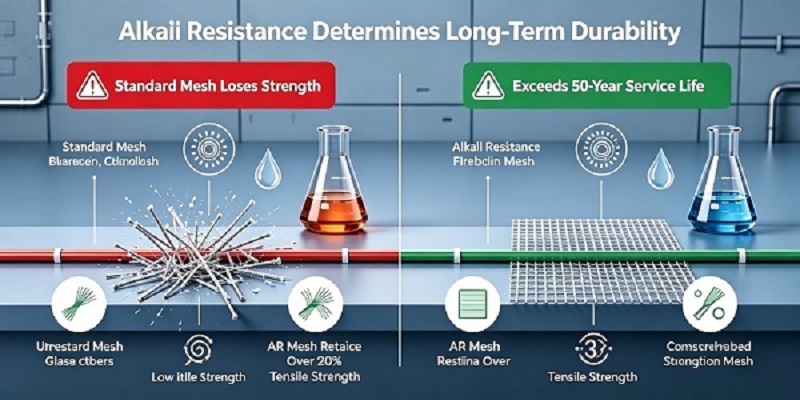
The cementitious environments in which these meshes are embedded are inherently aggressive. Standard glass fibers degrade rapidly when exposed to the high alkalinity of cement, lime, and other common building materials. Without proper protection, the reinforcement layer loses its integrity, leading to stress fractures, delamination, and eventual system failure. This is the core problem our product solves.
Our alkali-resistant mesh is manufactured from high-quality glass fiber yarns and treated with a specialized polymer coating that forms a protective barrier. This ensures that the mesh maintains its structural properties—particularly high tensile strength—over the long term. According to industry data, premium AR meshes can retain over 90% of their initial tensile strength after 28 days of immersion in alkaline solutions, ensuring a service life that exceeds 50 years.
High Tensile Strength: The Foundation of Crack Prevention
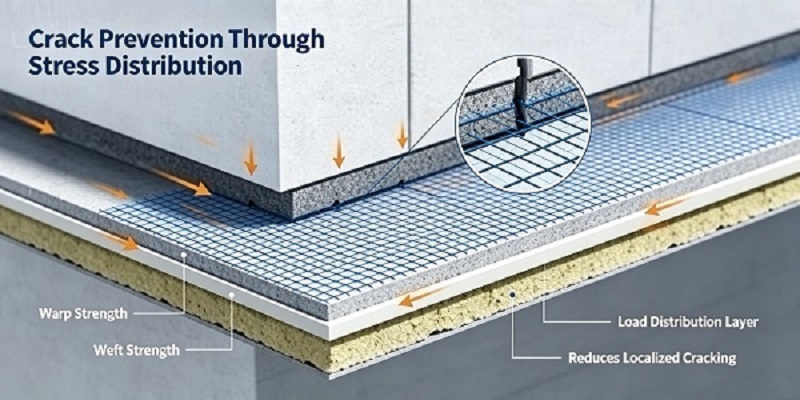
One of the primary functions of fiberglass mesh in EIFS and ETICS is wall crack prevention. As buildings settle, expand, and contract with temperature changes, stresses are transferred to the outer render layers. Without adequate reinforcement, these stresses manifest as unsightly and structurally compromising cracks.
Our mesh delivers high tensile strength in both the warp and weft directions, typically ranging from 1,200 to over 2,000 N per 5 cm depending on the specific weight and weave configuration. This high tensile capacity allows the mesh to act as a "load distributor," absorbing and spreading stress across the surface to prevent localized cracking.
Performance in EIFS and ETICS Systems
EIFS reinforcement requires a material that can be seamlessly embedded within the basecoat and provide reliable structural support. Our mesh is designed with consistent weave geometry and sufficient openness to allow for proper embedment without excessive mortar accumulation. This ensures optimal bonding with the surrounding materials and eliminates weak points in the system.
For ETICS system applications—the European standard for external thermal insulation composite systems—the mesh must comply with rigorous certification requirements such as ETAG 004. Our products are manufactured in line with these standards, offering verified tensile strength, excellent alkali resistance retention, and the dimensional stability required for system-wide approvals.
Choosing the Right Mesh for Your Project
The selection of the appropriate mesh weight—measured in grams per square meter (GSM)—is a critical decision with significant performance implications. Lighter meshes in the 60–80 g/m² range are suitable for internal plaster reinforcement and light-duty crack control. The 145 g/m² weight is the industry standard for most EIFS and ETICS applications, providing the optimal balance between strength and workability. For high-traffic areas, ground floors, or projects requiring enhanced impact resistance, a heavier 160 g/m² mesh offers superior protection.
Commitment to Quality and Service
Our manufacturing process employs advanced coating techniques and strict quality control to ensure consistency across every roll. We understand that on-site reliability is paramount, which is why we offer standard roll sizes along with customization options for large-scale B2B orders. Our technical team works closely with clients to provide specification guidance, ensuring the chosen mesh aligns perfectly with the project's performance requirements.
In summary, our high-strength alkali-resistant mesh is more than just a component—it is an investment in the long-term durability and performance of EIFS and ETICS systems. By combining high tensile strength, proven wall crack prevention, and steadfast resistance to alkaline degradation, we provide a reinforcement solution that construction professionals can trust.
Frequently Asked Questions (FAQ)
Q1: What makes alkali-resistant fiberglass mesh different from standard fiberglass mesh?
A: Standard glass fibers degrade rapidly in the alkaline environment of cement, losing strength and integrity. Alkali-resistant mesh is treated with specialized polymer coatings that form a protective barrier, allowing it to retain over 90% of its tensile strength even after extended exposure to alkaline conditions. This ensures long-term durability in EIFS and ETICS applications.
Q2: Which mesh weight should I choose for my EIFS project?
A: A 145 g/m² mesh is the standard choice for most EIFS and ETICS applications, offering a proven balance of strength and workability. For internal crack control or light-duty applications, a 60-80 g/m² mesh may be sufficient. For high-traffic areas or projects requiring enhanced impact resistance, a 160 g/m² heavy-duty mesh is recommended.
Q3: What are the key performance certifications for fiberglass mesh in ETICS systems?
A: The most recognized standard is ETAG 004, which governs External Thermal Insulation Composite Systems in Europe. ETAG-certified mesh ensures verified tensile strength, consistent weave geometry, and compliance with full system approvals. Other relevant standards include ASTM E2568 for the North American market and GB/T standards for China.
Q4: How does the mesh prevent wall cracking?
A: The mesh acts as a structural stabilizer within the render layer. When thermal movement, shrinkage, or mechanical stress occurs, the high tensile strength of the mesh absorbs and distributes these forces across the surface, preventing localized stress concentrations that would otherwise manifest as cracks.
Q5: What packaging and customization options are available for bulk orders?
A: We offer standard roll sizes (e.g., 1m x 50m) with plastic or shrink wrap packaging, label customization, and 2-inch paper cores. For large-scale B2B projects, we provide flexible roll size and packaging configurations upon request, along with technical specification support to ensure proper selection and installation.
Post time: Jul-15-2026
- English
- French
- German
- Portuguese
- Spanish
- Russian
- Japanese
- Korean
- Arabic
- Irish
- Greek
- Turkish
- Italian
- Danish
- Romanian
- Indonesian
- Czech
- Afrikaans
- Swedish
- Polish
- Basque
- Catalan
- Esperanto
- Hindi
- Lao
- Albanian
- Amharic
- Armenian
- Azerbaijani
- Belarusian
- Bengali
- Bosnian
- Bulgarian
- Cebuano
- Chichewa
- Corsican
- Croatian
- Dutch
- Estonian
- Filipino
- Finnish
- Frisian
- Galician
- Georgian
- Gujarati
- Haitian
- Hausa
- Hawaiian
- Hebrew
- Hmong
- Hungarian
- Icelandic
- Igbo
- Javanese
- Kannada
- Kazakh
- Khmer
- Kurdish
- Kyrgyz
- Latin
- Latvian
- Lithuanian
- Luxembou..
- Macedonian
- Malagasy
- Malay
- Malayalam
- Maltese
- Maori
- Marathi
- Mongolian
- Burmese
- Nepali
- Norwegian
- Pashto
- Persian
- Punjabi
- Serbian
- Sesotho
- Sinhala
- Slovak
- Slovenian
- Somali
- Samoan
- Scots Gaelic
- Shona
- Sindhi
- Sundanese
- Swahili
- Tajik
- Tamil
- Telugu
- Thai
- Ukrainian
- Urdu
- Uzbek
- Vietnamese
- Welsh
- Xhosa
- Yiddish
- Yoruba
- Zulu
- Kinyarwanda
- Tatar
- Oriya
- Turkmen
- Uyghur